KUKRIS

An original Mk II kukri.


Maharaja of Jodphur (Maharaja Sumer Sing, who ruled Jodphur from 1911 to 1918) choosed this kukri to be official sidearm for his police troops
as well for the troops he raised to support Britain in WW1.
Aluminum handle, blued blade. Kukri comes out from back of the scabbard.

Non-
MK II
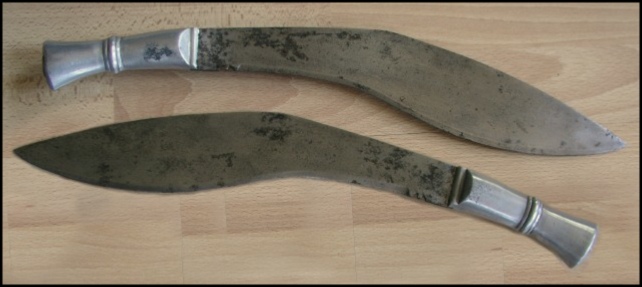
Another Jodhpur. No scabbard, no blueing left on blade.
WW2 KUKRI
Regards: Jodhpur Lancer Khukree
(ii) In IInd World War these Khukrees were given to each soldier of Jodhpur Lancer and troops by Maharaja Umaid Singhji of Jodhpur.
(iii) The Khukree bearings the insignia of Jodhpur State, though associated as personal weapon of Gurkhas (Nepalis), was very popular and a useful tool with the troops of the Jodhpur Lancer as well as Jodhpur Sardar Infantry.
(iv) The style and design of the Khukree is true copy of the khukree used in Nepal. This weapon is a special identity of Gorkhas of Nepal. The Maharaja of Jodhpur must have liked this handy tool for the personal security of the soldiers and issued them.
(v) The place of manufacture of these is not yet confirmed but I can assure you that (a) Jodhpur must be the place where these Khukrees were manufactured because this place is famous for iron skill and making of knifes of all sizes.
(b) Nagaur city, which is on the way of Bikaner only 150 KM far from Jodhpur in North direction. Nagour city is also one of the well-
(vi) Metal used in hilt is known as “White Metal”, which is mixture of few metals like Aluminum, German silver etc, this is only my perception.
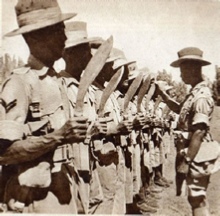
Another kukri of interest is an alloy handled model of rough, but sturdy, manufacture that was produced by the Maharaja of Jodhpur (fig. X) in northern India and given to both Indian and Nepalese troops of the 29th Indian Brigade before they left for Egypt enroute to parts of the Mideast and the tragedy of Gallipoli. The scabbard is a rare-
The Jodhpur Kukri, was until some years back thought of as a WW1 Kukri. Since JP wrote this material, several points have been found indicating that it actually most likely is a later production, in the 1950´s.
One of the Kukris on the middle image has the 2nd Gurkha Rifles insignia and the text "Delhi 1857-


Scabbard marked Cossapore Arsenal, 1945. Brass buttplate and bone hilt may indicate private purchase.
JODHPUR KUKRI
